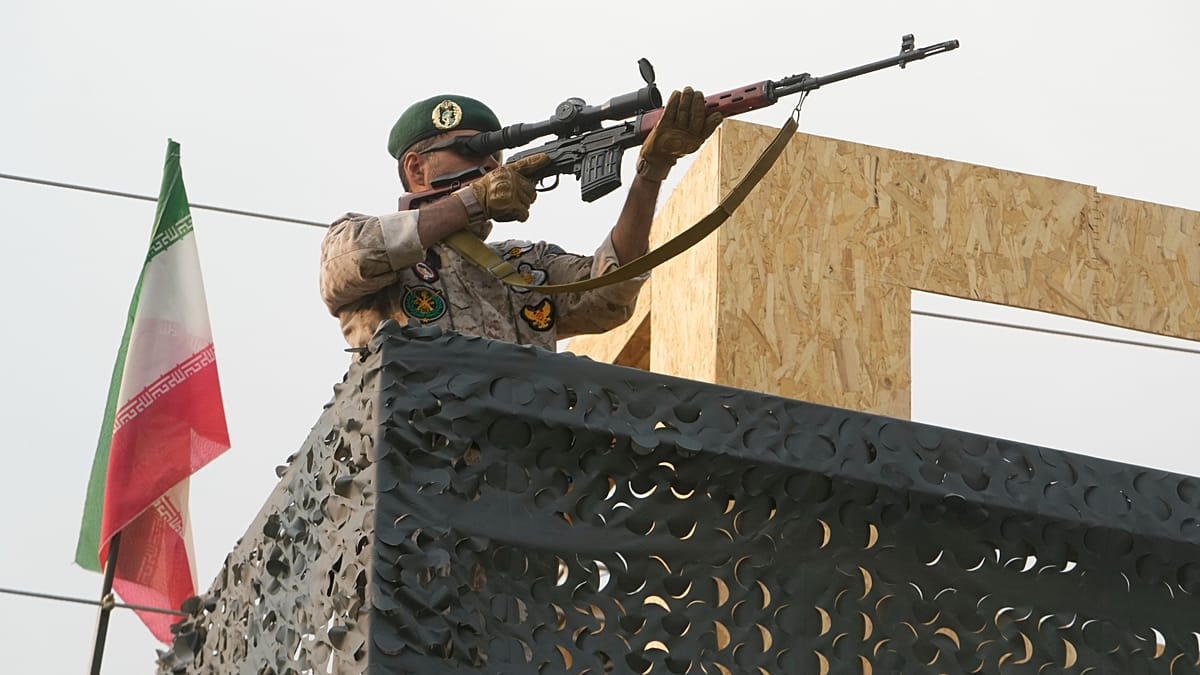
Iran's parliament speaker, Mohammad Bagher Ghalibaf, said on Tuesday that a misstep by the United States would create "a new battlefield in the war," speaking hours after reports that a US Air Force aircraft struck an IRGC missile system on Qeshm Island. According to Euronews.com, Ghalibaf told parliament that Iran stands at its highest level of defensive readiness and that Washington bears the responsibility for keeping the situation from worsening. "The ball is in America's court to prevent war," he said.
The reported strike followed overnight explosions and tremors felt by residents of Qeshm Island, Hengam and Bandar Abbas, which Iranian agencies IRNA and Fars reported, according to Euronews.com. US media accounts said the target was an IRGC surface-to-air missile launch system, hit after a missile was fired from Qeshm at a US aircraft in the Strait of Hormuz. Those reports described the operation as limited and intended to protect commercial shipping. CENTCOM has issued no formal statement either confirming or denying the accounts, and no Iranian military or government official has formally confirmed that the island was directly attacked.
Why it matters
The episode puts a confrontation that has largely played out through warnings and proxy friction back at the center of the Gulf's most sensitive waterway. Qeshm sits at the mouth of the Strait of Hormuz, the channel through which a large share of global seaborne energy trade passes, and any exchange of fire there carries consequences well beyond the two countries involved. The competing narratives — an unacknowledged US operation described through anonymous media accounts, and an Iranian leadership publicly raising the prospect of a wider war — leave the factual record unsettled even as the political stakes climb.
Drone claims and a widened target list
The IRGC said separately that its electronic warfare units brought down two US MQM-170 reconnaissance drones south of Qeshm Island and destroyed a US MQ-9 drone east of the Strait of Hormuz. Euronews.com reports that these claims, like the strike accounts, have not been independently confirmed.
Ghalibaf also invoked the authority of the late Ayatollah Ali Khamenei, saying that as commander-in-chief he had set out Iran's military strategy for responding to a possible attack. The parliament speaker said senior commanders met last week with Mojtaba Khamenei, described as the new supreme leader with direct control over the IRGC, and settled on what he called "a response without geographical limits," along with Tehran's right to decide when any conflict would end.
That formula has been read expansively by some Iranian figures. Manouchehr Mottaki, a former foreign minister who now sits in parliament, said on Sunday that in his interpretation it could bring US military bases in European countries — among them Britain, Italy, Portugal and Germany — into any fighting. "If our war is to break out, it will no longer be a regional war, it will be extraregional," he said, according to Euronews.com.
The Tehran-based newspaper Hamshahri reported on Tuesday that Iran has revised its "target bank," and that it has studied a scenario in which American support bases and infrastructure in Europe would be struck under the same no-limits doctrine.
Diplomacy kept open with Gulf neighbors
Alongside the military messaging, Foreign Minister Abbas Araghchi signaled that channels to the Gulf remain open. In a post on X, he said Iran holds no hostility toward the Gulf Cooperation Council states, praised what he called the constructive role of Qatar and Oman, and said dialogue with Saudi Arabia is continuing. Euronews.com reports his comments as an expression of support for Gulf mediation.
The two tracks — a public threat to extend any war beyond the region and an open line to Gulf capitals — have run in parallel before in Iranian statements, and the contrast here is sharp. Tehran appears to be signaling that it wants regional governments to help contain the crisis while warning Washington that escalation would not stay confined to the Gulf.
What to watch next is whether CENTCOM breaks its silence on the Qeshm accounts, and whether the Gulf mediation Araghchi welcomed produces any visible channel between Washington and Tehran.